



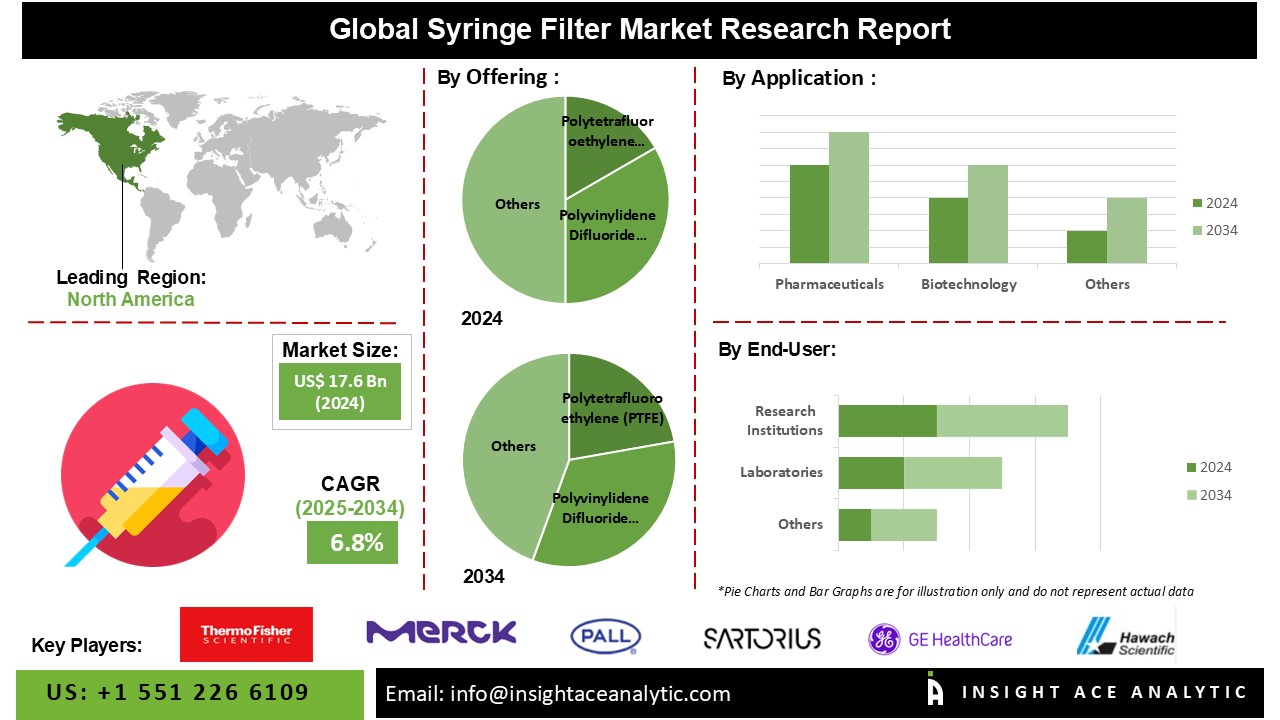
Global Syringe Filter Market Size is valued at USD 17.6 Bn in 2024 and is predicted to reach USD 33.1 Bn by the year 2034 at a 6.8% CAGR during the forecast period for 2025-2034.
The Syringe Filter Market offers a comprehensive array of filtration solutions utilized across various industries, including pharmaceuticals, biotechnology, healthcare, and environmental monitoring. These filters are engineered to eliminate particulate matter, bacteria, and other contaminants from liquid samples, ensuring the purity and precision of analytical processes. The demand for syringe filters in laboratories is propelled by their increasing applications in life sciences and biotechnology research, driven by advancements in drug development and biopharmaceuticals. The adoption of syringe filters is further accelerated by stringent quality control measures and regulatory standards in the pharmaceutical and biotech sectors, ensuring precise and contaminant-free research outcomes.
Advancements in drug development, biopharmaceuticals, and biotechnology research contribute significantly to the expanding demand for syringe filters in laboratory settings. Additionally, the widening scope of environmental monitoring, fueled by concerns surrounding water and air quality, amplifies the use of syringe filters in sample preparation for accurate analysis. Furthermore, with a growing emphasis on point-of-care diagnostics, syringe filters have the potential to play a crucial role in ensuring sample purity for rapid and precise diagnostic testing. The burgeoning healthcare markets in regions like Asia-Pacific present significant opportunities for increased adoption of laboratory filtration solutions, bolstering market growth.
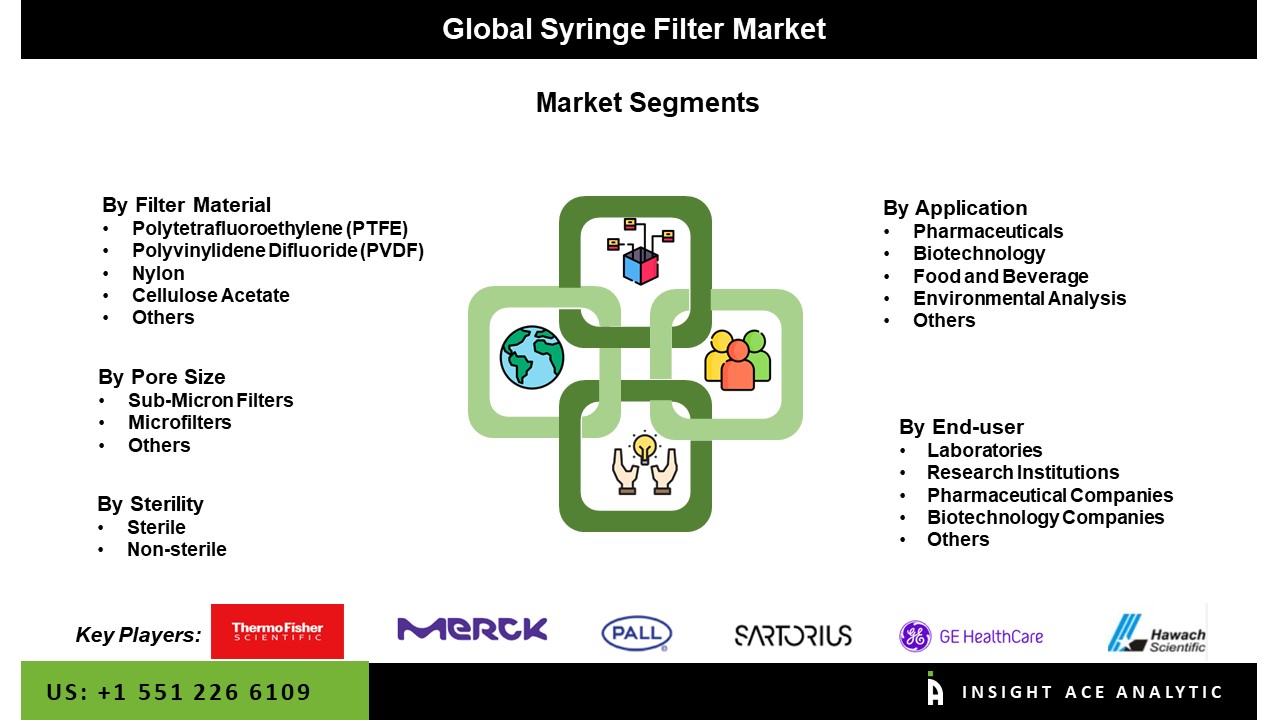
The Syringe Filter Market is segmented on the basis of filter type, Application, and end user. Based on filter type, the Syringe Filter market is segmented as, the market is segmented as Polytetrafluoroethylene (PTFE), Polyvinylidene Difluoride (PVDF), Nylon, Cellulose Acetate, Others), Pore Size is categorized into Sub-Micron Filters, Microfilters, and Others, By Sterlity the market is segmented as sterile and non-sterile, By Application, the market is segmented as Pharmaceuticals, Biotechnology, Food and Beverage, Environmental Analysis, Others), By End User, the market is segmented as Laboratories, Research Institutions, Pharmaceutical Companies, Biotechnology Companies, Others.
The microfilters category is expected to hold a major share of the global syringe filter market in 2024. Microfilters within the syringe filter market, featuring pore sizes typically ranging from one to ten microns, serve a wide range of laboratory needs. There is a noticeable trend toward increased utilization of microfilters in environmental monitoring, food and beverage analysis, and general laboratory investigations, driven by their versatility and efficient removal of particulate matter.
The pharmaceutical company’s segment is projected to develop at a rapid rate in the global syringe filter market. Emerging pharmaceutical companies in various regions around the world are experiencing notable growth and innovation. These companies are making significant contributions to the pharmaceutical industry by introducing novel drugs, leveraging advanced technologies, and addressing unmet medical needs. Syringe filters play a crucial role in helping pharmaceutical companies meet rigorous quality control standards during drug development. An emerging trend involves the uptake of syringe filters featuring advanced membrane technologies to boost the efficacy of pharmaceutical research and production processes.
The North America Syringe Filter Market is expected to register the highest market share. The syringe filter market in North America presents prospects for development and innovation, driven by the rising need for reliable filtration solutions across various industries and applications. In addition, the Asia Pacific region is projected to extend at a decreasing rate in the global syringe filter market. Factors like the rising prevalence of diseases requiring diagnostic testing, the expansion of the healthcare sector, and the growing emphasis on drug purity and safety contribute to the demand for syringe filters in the region. Market players may also consider factors such as competition from alternative filtration methods, pricing strategies, and distribution networks when operating in this market.
| Report Attribute | Specifications |
| Market Size Value In 2024 | USD 17.6 Bn |
| Revenue Forecast In 2034 | USD 33.1 Bn |
| Growth Rate CAGR | CAGR of 6.8% from 2025 to 2034 |
| Quantitative Units | Representation of revenue in US$ Bn and CAGR from 2025 to 2034 |
| Historic Year | 2021 to 2024 |
| Forecast Year | 2025-2034 |
| Report Coverage | The forecast of revenue, the position of the company, the competitive market structure, growth prospects, and trends |
| Segments Covered | By Filter Material, Pore Size, Application, Sterility, End User |
| Regional Scope | North America; Europe; Asia Pacific; Latin America; Middle East & Africa |
| Country Scope | U.S.; Canada; U.K.; Germany; China; India; Japan; Brazil; Mexico; France; Italy; Spain; Southeast Asia; South Korea |
| Competitive Landscape | Merck Group, Thermo Fisher Scientific Inc., Pall Corporation, Sartorius Group, GE HealthcarMilliporeSigma (Merck Group, Advantec MFS Inc., Sterlitech Corporation, Whatman (Cytiva, Restek Corporation, Sigma-Aldrich (Merck Group, Hawach Scientific Co. Ltd., CHMLAB Group, Axiva Sichem Biotec, Anow Microfiltration Co. Ltd., MACHEREY-NAGEL, Hach, Agilent, Advanced Microdevices Pvt. Ltd, VWR International, LLC., Membrane Solutions,LLC., Corning Incorporated, HiMedia Laboratories, CELLTREAT Scientific Products, J-SIL, Phenomenex, Shimadzu Corporation, PerkinElmer And Others |
| Customization Scope | Free customization report with the procurement of the report and modifications to the regional and segment scope. Particular Geographic competitive landscape. |
| Pricing And Available Payment Methods | Explore pricing alternatives that are customized to your particular study requirements. |
Syringe Filter Market By Filter Material
Syringe Filter Market By Pore Size
Syringe Filter Market By Sterlity
Syringe Filter Market By Application
Syringe Filter Market By End User
Syringe Filter Market By Region-
North America-
Europe-
Asia-Pacific-
Latin America-
Middle East & Africa-
This study employed a multi-step, mixed-method research approach that integrates:
This approach ensures a balanced and validated understanding of both macro- and micro-level market factors influencing the market.
Secondary research for this study involved the collection, review, and analysis of publicly available and paid data sources to build the initial fact base, understand historical market behaviour, identify data gaps, and refine the hypotheses for primary research.
Secondary data for the market study was gathered from multiple credible sources, including:
These sources were used to compile historical data, market volumes/prices, industry trends, technological developments, and competitive insights.

Primary research was conducted to validate secondary data, understand real-time market dynamics, capture price points and adoption trends, and verify the assumptions used in the market modelling.
Primary interviews for this study involved:
Interviews were conducted via:
Primary insights were incorporated into demand modelling, pricing analysis, technology evaluation, and market share estimation.
All collected data were processed and normalized to ensure consistency and comparability across regions and time frames.
The data validation process included:
This ensured that the dataset used for modelling was clean, robust, and reliable.
The bottom-up approach involved aggregating segment-level data, such as:
This method was primarily used when detailed micro-level market data were available.

The top-down approach used macro-level indicators:
This approach was used for segments where granular data were limited or inconsistent.
To ensure accuracy, a triangulated hybrid model was used. This included:
This multi-angle validation yielded the final market size.
Market forecasts were developed using a combination of time-series modelling, adoption curve analysis, and driver-based forecasting tools.
Given inherent uncertainties, three scenarios were constructed:
Sensitivity testing was conducted on key variables, including pricing, demand elasticity, and regional adoption.