Immersive Reality for Defence Market Size, Share & Trends Analys is Report By By Application (3D Modeling, Simulation and Training, Maintenance and Monitoring, Situational Awareness), By Type (Augmented Reality (AR), Virtual Reality (VR), Mixed Reality (MR)), By Component, By Device, By Region, And By Segment Forecasts, 2025-2034
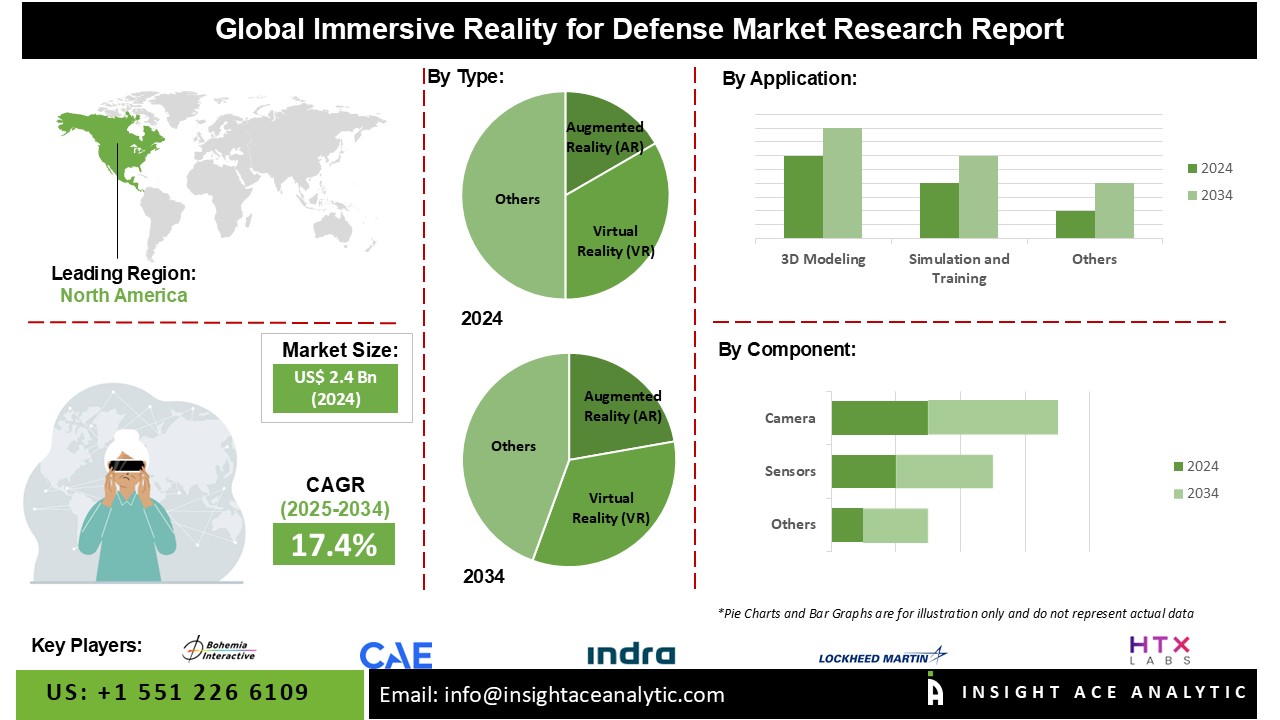
Global Immersive Reality for Defence Market Size is valued at USD 2.46 Bn in 2024 and is predicted to reach USD 12.03 Bn by the year 2034 at a 17.4% CAGR during the forecast period for 2025-2034.
Immersive Reality for Defense refers to using VR/AR/MR technologies in defense-related fields to improve their capacity for simulation, training, and actual operations. Training, simulation, and operational efficiency are just areas where virtual reality technology revolutionizes defence applications. This state-of-the-art technology is crucial to modern military operations because of its advantages in terms of efficiency, realism, and versatility. Training and simulation are two of the key defence applications of V.R. technology. In a controlled and safe setting, soldiers can practice their abilities and learn new tactics in realistic combat scenarios using virtual reality (V.R.) and augmented reality (A.R.) technology. Furthermore, Drone piloting and remote work both benefit greatly from the use of virtual reality. When pilots don V.R. goggles, they may pilot drones and other uncrewed vehicles as if they were physically present.
However, the market growth is hampered by the strict regulatory criteria for the safety and health of immersive reality for the defence market. The product's inability to prevent fog in environments with dramatic temperature fluctuations or high humidity immersive reality and widespread adoption of immersive reality solutions is hindered by cybersickness, a syndrome similar to motion sickness caused by perceptual incongruity in virtual settings. Defence personnel may experience discomfort, confusion, and decreased operational effectiveness due to sensory conflicts between visual and vestibular inputs caused by the realistic character of these settings.
Cybersickness prevention must take into account both hardware and software improvements as well as user adaption techniques. Several prominent virtual reality (V.R.) incidents of the COVID-19 incident impacted immersive technology firms. Stay-at-home orders led to the closure of virtual reality gaming centres in the early months of the pandemic. In contrast, the consumer V.R. market has seen widespread expansion. During the lockdown, the majority of people spent money on virtual reality games to push the boundaries of gaming.
Competitive Landscape
Some Major Key Players In The Immersive Reality for Defence Market:
- Bohemia Interactive Simulations
- CAE, Inc.
- HTX Labs
- Indra Sistemas, SA.
- Lockheed Martin
- Red Six Aerospace, Inc.
- SimX
- Thales Group
- VRgineers, Inc.
- Varjo
- Acer Inc.,
- Atheer, Inc.,
- AVEVA Group PLC,
- Barco NV,
- Blippar Ltd.,
- Carl Zeiss AG,
- CM Labs Simulations Inc.,
- EON Reality, Inc.,
- FAAC Incorporated,
- Google, LLC,
- HCL Technologies Limited,
- Honeywell International, Inc.,
- HTC Corporation,
- Immersive Media Company,
- Immersive Technologies Pty Limited,
- Lockheed Martin Corporation,
- Magic Leap, Inc.,
- NCTech Limited,
- Oculus (Facebook Technologies, LLC.),
- Samsung Group,
- Sony Corporation,
- Unity Software Inc.,
- VI-grade GmbH,
- Zeality Inc.
- Others
Market Segmentation:
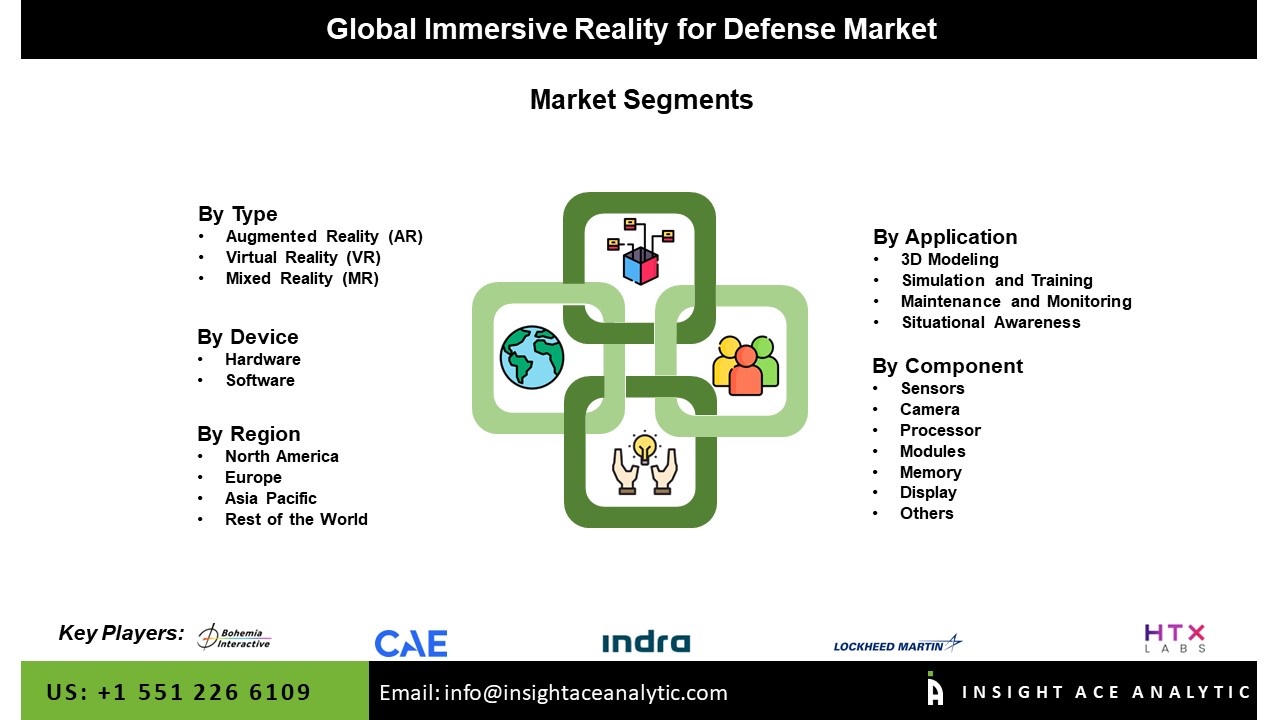
The immersive reality for the defence market is segmented based on application, type, component, and device. As per the application, the market is categorized into 3D Modeling, simulation and training, maintenance and monitoring, and situational awareness. By type, the market is segmented into augmented reality (A.R.), virtual reality (V.R.), mixed, and reality (M.R.). As per the component, the market is segmented into Sensors, Cameras, Processors, Modules, Memory, Display, and Others. By device, the market is segmented into Hardware and Software.
Based On The Component, The Sensor's Immersive Reality For The Defence Market Segment Is A Major Contributor To The Immersive Reality For The Defence Market.
The Sensor's immersive reality for the defence market is expected to record a major global market share in 2022. Sensors are crucial to every industrial process because of the information they provide regarding the state of the machinery. Keeping a process running smoothly requires constantly monitoring data in real-time and adjusting as needed.
Software Segment To Witness Growth At A Rapid Rate.
The software industry makes up the bulk of immersive reality for the defence market because software is quite helpful for the user, especially in a corporate setting. It assists in compiling any necessary records and files for a business, as well as group communication and establishing a streamlined safety and security system, especially in countries like the US, Germany, the UK, China, and India.
The North American Immersive Reality For The Defence Market Leads To A Significant Revenue Share In The Region.
The North American immersive reality for the defence market is expected to record the maximum market share in revenue in the near future. This can be attributed to the fact that there are already major companies and new start-ups in the immersive virtual reality space, which bodes well for the market's future expansion. North America is ahead of other parts of the world because it has been an early adopter of advancements. In addition, Asia Pacific is estimated to grow rapidly in the global immersive reality for the defence market because Increased use of virtual reality (V.R.) technology in industries such as aerospace and defence and architecture and planning could present a significant opportunity for the expansion of this market.
Recent Developments:
- In August 2023, HTX Labs and Vinci VR joined to create and distribute immersive training solutions on the EMPACT platform. The EMPACT platform provides an end-to-end answer for safe, centralized content management, user-generated courseware development, and device-agnostic distribution.
- In June 2022, Bohemia Interactive Simulations (BISim) was granted a 7.2 million pound ($8.7 million) contract by the UK Ministry of Defence to provide the Defense Virtual Simulation 2 (DVS2) solution. By utilizing the DVS2 solution, military personnel were able to simulate the operation of diverse equipment across an extensive array of terrains
Immersive Reality for Defence Market Report Scope
| Report Attribute | Specifications |
| Market Size Value In 2024 | USD 2.46 Bn |
| Revenue Forecast In 2034 | USD 12.03 Bn |
| Growth Rate CAGR | CAGR of 17.4% from 2025 to 2034 |
| Quantitative Units | Representation of revenue in US$ Million and CAGR from 2025 to 2034 |
| Historic Year | 2021 to 2024 |
| Forecast Year | 2025-2034 |
| Report Coverage | The forecast of revenue, the position of the company, the competitive market structure, growth prospects, and trends |
| Segments Covered | By Application, Type, Component, Device |
| Regional Scope | North America; Europe; Asia Pacific; Latin America; Middle East & Africa |
| Country Scope | U.S.; Canada; U.K.; Germany; China; India; Japan; Brazil; Mexico ;The UK; France; Italy; Spain; South Korea; South East Asia |
| Competitive Landscape | Bohemia Interactive Simulations, CAE, Inc., HTX Labs, Indra, Sistemas, S.A., Lockheed Martin, Red Six Aerospace, Inc., SimX, Thales Group, VRgineers, Inc., Acer Inc., Atheer, Inc., AVEVA Group PLC, Barco NV, Blippar Ltd., Carl Zeiss AG, CM Labs Simulations Inc., EON Reality, Inc., FAAC Incorporated, Google, LLC, HCL Technologies Limited, Honeywell International, Inc., HTC Corporation, Immersive Media Company, Immersive Technologies Pty Limited, Lockheed Martin Corporation, Magic Leap, Inc., NCTech Limited, Oculus (Facebook Technologies, LLC.), Samsung Group, Sony Corporation, Unity Software Inc., Varjo Technologies Oy, VI-grade GmbH, Zeality Inc. |
| Customization Scope | Free customization report with the procurement of the report and modifications to the regional and segment scope. Particular Geographic competitive landscape. |
| Pricing And Available Payment Methods | Explore pricing alternatives that are customized to your particular study requirements. |
Segmentation Of Immersive Reality For Defense Market-
Immersive Reality For Defense Market By Application-
- 3D Modeling
- Simulation and Training
- Maintenance and Monitoring
- Situational Awareness
Immersive Reality For Defense Market By Type-
- Augmented Reality (AR)
- Virtual Reality (VR)
- Mixed Reality (MR)
Immersive Reality For Defense Market By Component-
- Sensors
- Camera
- Processor
- Modules
- Memory
- Display
- Others
Immersive Reality For Defense Market By Device-
- Hardware
- Headsets
- Head Mounted Displays (HMD)
- Handheld Devices
- Others
- Software
- Visualization and Documentation
- 3D Modeling
- Navigation
- Others
Immersive Reality For Defense Market By Region-
North America-
- The US
- Canada
Europe-
- Germany
- The UK
- France
- Italy
- Spain
- Rest of Europe
Asia-Pacific-
- China
- Japan
- India
- South Korea
- South East Asia
- Rest of Asia Pacific
Latin America-
- Brazil
- Argentina
- Mexico
- Rest of Latin America
Middle East & Africa-
- GCC Countries
- South Africa
- Rest of the Middle East and Africa
Research Design and Approach
This study employed a multi-step, mixed-method research approach that integrates:
- Secondary research
- Primary research
- Data triangulation
- Hybrid top-down and bottom-up modelling
- Forecasting and scenario analysis
This approach ensures a balanced and validated understanding of both macro- and micro-level market factors influencing the market.
Secondary Research
Secondary research for this study involved the collection, review, and analysis of publicly available and paid data sources to build the initial fact base, understand historical market behaviour, identify data gaps, and refine the hypotheses for primary research.
Sources Consulted
Secondary data for the market study was gathered from multiple credible sources, including:
- Government databases, regulatory bodies, and public institutions
- International organizations (WHO, OECD, IMF, World Bank, etc.)
- Commercial and paid databases
- Industry associations, trade publications, and technical journals
- Company annual reports, investor presentations, press releases, and SEC filings
- Academic research papers, patents, and scientific literature
- Previous market research publications and syndicated reports
These sources were used to compile historical data, market volumes/prices, industry trends, technological developments, and competitive insights.

Primary Research
Primary research was conducted to validate secondary data, understand real-time market dynamics, capture price points and adoption trends, and verify the assumptions used in the market modelling.
Stakeholders Interviewed
Primary interviews for this study involved:
- Manufacturers and suppliers in the market value chain
- Distributors, channel partners, and integrators
- End-users / customers (e.g., hospitals, labs, enterprises, consumers, etc., depending on the market)
- Industry experts, technology specialists, consultants, and regulatory professionals
- Senior executives (CEOs, CTOs, VPs, Directors) and product managers
Interview Process
Interviews were conducted via:
- Structured and semi-structured questionnaires
- Telephonic and video interactions
- Email correspondences
- Expert consultation sessions
Primary insights were incorporated into demand modelling, pricing analysis, technology evaluation, and market share estimation.
Data Processing, Normalization, and Validation
All collected data were processed and normalized to ensure consistency and comparability across regions and time frames.
The data validation process included:
- Standardization of units (currency conversions, volume units, inflation adjustments)
- Cross-verification of data points across multiple secondary sources
- Normalization of inconsistent datasets
- Identification and resolution of data gaps
- Outlier detection and removal through algorithmic and manual checks
- Plausibility and coherence checks across segments and geographies
This ensured that the dataset used for modelling was clean, robust, and reliable.
Market Size Estimation and Data Triangulation
Bottom-Up Approach
The bottom-up approach involved aggregating segment-level data, such as:
- Company revenues
- Product-level sales
- Installed base/usage volumes
- Adoption and penetration rates
- Pricing analysis
This method was primarily used when detailed micro-level market data were available.

Top-Down Approach
The top-down approach used macro-level indicators:
- Parent market benchmarks
- Global/regional industry trends
- Economic indicators (GDP, demographics, spending patterns)
- Penetration and usage ratios
This approach was used for segments where granular data were limited or inconsistent.
Hybrid Triangulation Approach
To ensure accuracy, a triangulated hybrid model was used. This included:
- Reconciling top-down and bottom-up estimates
- Cross-checking revenues, volumes, and pricing assumptions
- Incorporating expert insights to validate segment splits and adoption rates
This multi-angle validation yielded the final market size.
Forecasting Framework and Scenario Modelling
Market forecasts were developed using a combination of time-series modelling, adoption curve analysis, and driver-based forecasting tools.
Forecasting Methods
- Time-series modelling
- S-curve and diffusion models (for emerging technologies)
- Driver-based forecasting (GDP, disposable income, adoption rates, regulatory changes)
- Price elasticity models
- Market maturity and lifecycle-based projections
Scenario Analysis
Given inherent uncertainties, three scenarios were constructed:
- Base-Case Scenario: Expected trajectory under current conditions
- Optimistic Scenario: High adoption, favourable regulation, strong economic tailwinds
- Conservative Scenario: Slow adoption, regulatory delays, economic constraints
Sensitivity testing was conducted on key variables, including pricing, demand elasticity, and regional adoption.
Request Customization
Add countries, segments, company profiles, or extend forecast — free 10% customization with purchase.
Customize This Report →Enquire Before Buying
Speak with our analyst team about scope, methodology, pricing, or deliverable formats.
Enquire Now →Frequently Asked Questions
Immersive Reality for Defence Market Size is valued at USD 2.46 Bn in 2024 and is predicted to reach USD 12.03 Bn by the year 2034
Immersive Reality for Defence Market expected to grow at a 17.4% CAGR during the forecast period for 2025-2034.
Samsung Group, Sony Corporation, Unity Software Inc., Varjo Technologies Oy, VI-grade GmbH, Zeality Inc.
Application, Type, Component and Device are the four key segments of the Immersive Reality for Defence Market.
North American Region is leading the Immersive Reality for Defence Market.