Antimicrobial Coatings Market Size, Share & Trends Analysis Report By Type (Silver, Copper And Titanium Dioxide) And End-Use Industry (Medical & Healthcare, Building & Construction, Protective Clothing, HVAC System, And Transportation Automotive), By Region, And Segment Forecasts, 2025-2034
Antimicrobial Coatings Market Size is valued at 12.6 billion in 2024 and is predicted to reach 44.2 billion by the year 2034 at an 13.5% CAGR during the forecast period for 2025-2034.
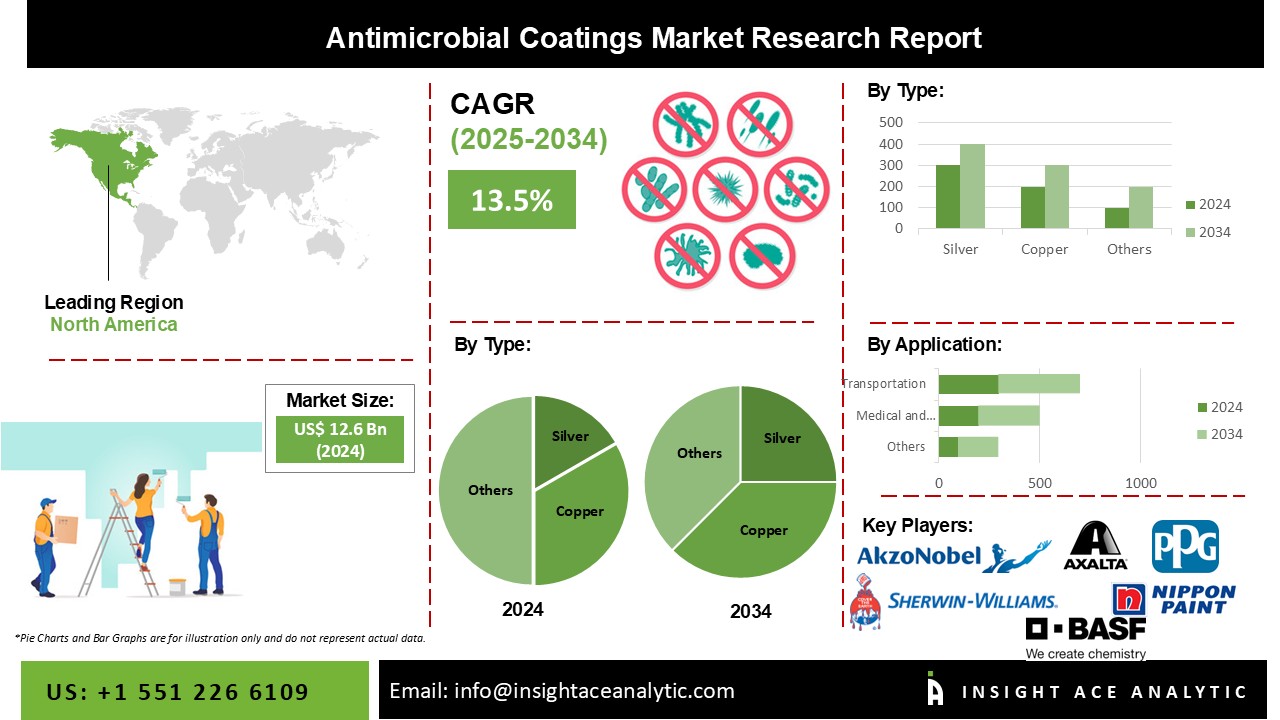
The antimicrobial coating is a chemical substance that aids in stopping the development of dangerous bacteria, mould, viruses, and germs on the surfaces where it has been applied. The most often utilized antimicrobial coatings are used on walls, doorknobs, counters, and other frequently handled surfaces. By lowering the contamination, discoloration, and odor brought on by bacterial development, coatings increase value and enhance the functionality of the coated product.
Hospitals, clinics, the food and beverage industry, pharmaceutical manufacturing facilities, and new buildings frequently employ these coatings. Surfaces are being protected more often from bacteria and other microorganisms. It applies to more than only medical equipment and surfaces, and the demand is more widespread. Microbes are sensitive to everything, including people, clothing, and food. To stop the spread of germs, surfaces cannot be constantly cleaned, disinfected, or treated with potent chemicals. The most suitable alternative for cleaning seems to be antimicrobial coatings.
By preventing the growth of unwelcome bacteria, which can either cause diseases or cause the product to degrade, it protects against numerous microbial invasions. Additionally, it offers fungus protection, which is regarded as a crucial property for particular outdoor applications. The wider use of these coatings in the healthcare sector increases the need for antimicrobial coating.
Moreover, The elderly population, declining fertility rates, and increasing life expectancy are other factors. Healthcare delivery and health improvement depend heavily on medical devices. The growing number of healthcare sectors use specific infection control measures that use medical equipment treated with antibiotics.
Recent Developments:
- In Oct 2022, BASF and Hannong Chemicals intended to establish a strategic production alliance called "BASF Hannong Chemicals Solutions Ltd." The joint venture will combine BASF's robust technology and product innovation capabilities with Hannong's highly efficient production capabilities to supply best-in-class non-ionic surfactant products to BASF and Hannong Chemicals, both of which have their own sales and distribution networks, allowing the two companies to meet rising market demand.
- In May 2020, in consideration of the pandemic, AkzoNobel re-released the Interpon D1000 and 2000 architectural powder coatings.
Competitive Landscape:
Some of the major key players in the antimicrobial coatings market are:
- Advanced Nanotech Lab (Ant Lab)
- AK Steel Corp.
- AkzoNobel N.V.
- Apogee Enterprises, Inc
- Axalta Coating Systems
- Burke Industrial Coatings
- Diamond Vogel
- Dow Chemical Company
- I. Du Pont De Nemours
- Jotun Group
- Koninklijke DSM N.V.
- Lonza
- Nippon Paint Holdings Co., Ltd.
- Novapura Ag
- PPG Industries, Inc.
- Pylon Coatings
- RPM International Inc.
- Sciessent Llc
- Sika AG
- The Sherwin-Williams Company
- Troy Corporation
Market Segmentation:
The Antimicrobial Coatings Market is segmented into the type and end-use industry. Based on type, the market is segmented into silver, copper and titanium dioxide. Based on the end-use industry, the market is segmented into medical & healthcare, building & construction, protective clothing, HVAC system, and transportation automotive.
By type, the silver segment will have the largest market share.
The silver category will hold the most substantial market share by product type during the forecast period. The effectiveness of these coatings against many viruses, bacteria, and other microbes is very significant. When silver-based antimicrobial coatings are applied to substrate surfaces, a controlled release of silver ions occurs, which prevents pathogens and bacteria from growing on the surface. The manufacturers' efforts and technological advancements to add silver-based antimicrobial coatings to medical devices, including surgical instruments and others, boost market expansion.
The medical & healthcare segment witnessed growth at a rapid rate.
Based on the application, the medical devices segment is expected to have the largest market share: The medical & healthcare category is anticipated to hold the largest market share over the forecast period. The demand for antimicrobial coatings used on medical equipment has increased because they aid in preventing the growth of various bacteria, parasites, germs, and fungi on their surfaces. The availability of healthcare infrastructure is critical, and it is anticipated that both industrialized and developing countries will see a growth in the number of healthcare services.
In the region, the North American Antimicrobial Coatings Market holds a significant revenue share.
The antimicrobial coatings market is predicted to be dominated by the North American area. Due to the existence of several manufacturing enterprises in this region, particularly the United States, it is anticipated that this region would hold a dominant position. During the projection period, the market growth in this area will be driven by the presence of government initiatives that guarantee better healthcare facilities for the general populace. Besides, the most considerable portion of the global market for antimicrobial coatings was represented by Asia Pacific. Growing prospects for investment in the Asia Pacific region are projected to arise from the construction, pharmaceutical, and food and beverage industries. The demand for medical products and medications has grown as a result of both an ageing population and a rise in the number of people suffering from chronic illnesses like diabetes and cardiovascular disease. Therefore, hospitals must take extra precautions for infection control and hygiene, which is likely to increase the demand for healthcare services in this region.
Antimicrobial Coatings Market Report Scope
| Report Attribute | Specifications |
| Market size value in 2024 | USD 12.6 billion |
| Revenue forecast in 2034 | USD 44.2 billion |
| Growth rate CAGR | CAGR of 13.5% from 2025 to 2034 |
| Quantitative units | Representation of revenue in US$ Million, Volume in Ton and CAGR from 2023 to 2031 |
| Historic Year | 2021 to 2024 |
| Forecast Year | 2025-2034 |
| Report coverage | The forecast of revenue, the position of the company, the competitive market structure, growth prospects, and trends |
| Segments covered | Type, End-user Industry |
| Regional scope | North America; Europe; Asia Pacific; Latin America; Middle East & Africa |
| Country scope | U.S.; Canada; U.K.; Germany; China; India; Japan; Brazil; Mexico; The UK; France; Italy; Spain; South Korea; Southeast Asia |
| Competitive Landscape | AkzoNobel N.V. (Netherlands), Axalta Coating Systems Ltd. (US), The Sherwin-Williams Company (US), BASF (Germany), PPG Industries Inc (US), Nippon Paint Holdings Co. Ltd. (Japan), RPM International Inc. (US), Koninkijke DSM N.V (Netherland), Sika AG (Switzerland), Lanxess AG (Germany) and others |
| Customization scope | Free customization report with the procurement of the report, Modifications to the regional and segment scope. Particular Geographic competitive landscape. |
| Pricing and available payment methods | Explore pricing alternatives that are customized to your particular study requirements. |
Segmentation of Antimicrobial Coatings Market:
Antimicrobial Coatings Market By Type-
- Silver
- Copper
- Titanium Dioxide
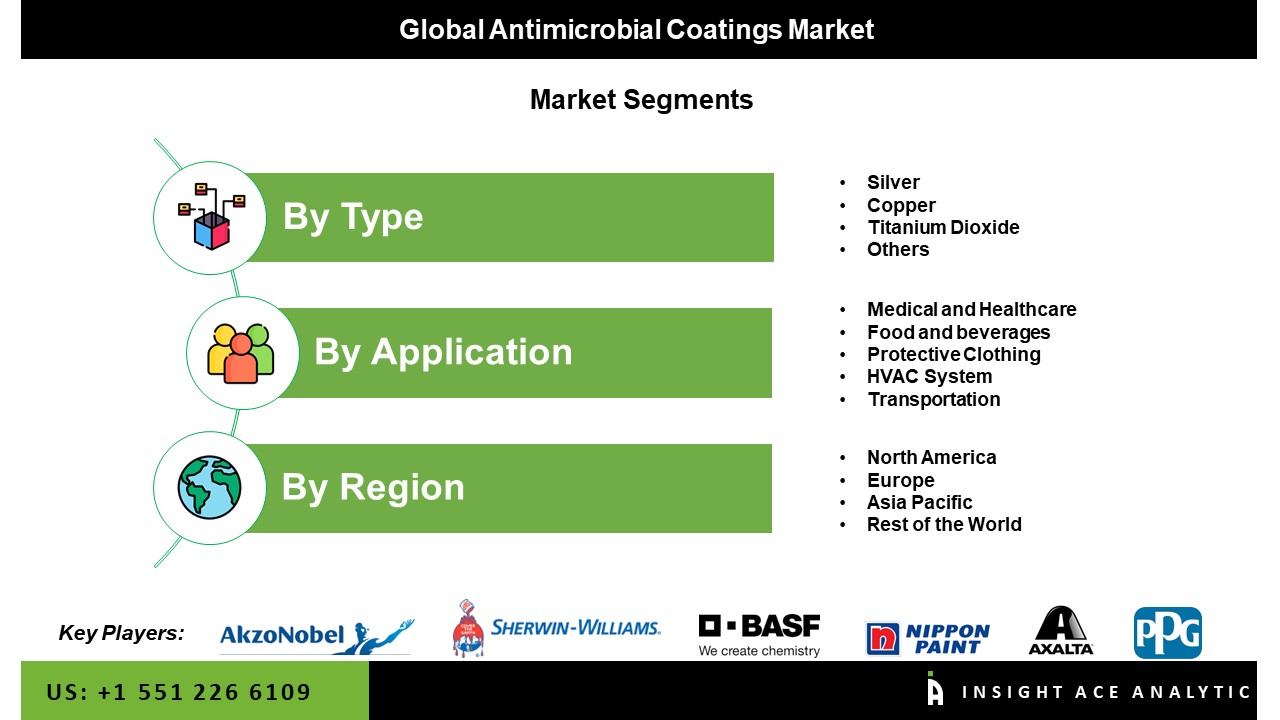
Antimicrobial Coatings Market By End use industry-
- Medical & Healthcare
- Building & Construction
- Protective Clothing
- HVAC System
- Transportation Automotive
Antimicrobial Coatings Market By Region-
North America-
- The US
- Canada
Europe-
- Germany
- The UK
- France
- Italy
- Spain
- Rest of Europe
Asia-Pacific-
- China
- Japan
- India
- South Korea
- Southeast Asia
- Rest of Asia Pacific
Latin America-
- Brazil
- Argentina
- Mexico
- Rest of Latin America
Middle East & Africa-
- GCC Countries
- South Africa
- Rest of Middle East and Africa
Research Design and Approach
This study employed a multi-step, mixed-method research approach that integrates:
- Secondary research
- Primary research
- Data triangulation
- Hybrid top-down and bottom-up modelling
- Forecasting and scenario analysis
This approach ensures a balanced and validated understanding of both macro- and micro-level market factors influencing the market.
Secondary Research
Secondary research for this study involved the collection, review, and analysis of publicly available and paid data sources to build the initial fact base, understand historical market behaviour, identify data gaps, and refine the hypotheses for primary research.
Sources Consulted
Secondary data for the market study was gathered from multiple credible sources, including:
- Government databases, regulatory bodies, and public institutions
- International organizations (WHO, OECD, IMF, World Bank, etc.)
- Commercial and paid databases
- Industry associations, trade publications, and technical journals
- Company annual reports, investor presentations, press releases, and SEC filings
- Academic research papers, patents, and scientific literature
- Previous market research publications and syndicated reports
These sources were used to compile historical data, market volumes/prices, industry trends, technological developments, and competitive insights.

Primary Research
Primary research was conducted to validate secondary data, understand real-time market dynamics, capture price points and adoption trends, and verify the assumptions used in the market modelling.
Stakeholders Interviewed
Primary interviews for this study involved:
- Manufacturers and suppliers in the market value chain
- Distributors, channel partners, and integrators
- End-users / customers (e.g., hospitals, labs, enterprises, consumers, etc., depending on the market)
- Industry experts, technology specialists, consultants, and regulatory professionals
- Senior executives (CEOs, CTOs, VPs, Directors) and product managers
Interview Process
Interviews were conducted via:
- Structured and semi-structured questionnaires
- Telephonic and video interactions
- Email correspondences
- Expert consultation sessions
Primary insights were incorporated into demand modelling, pricing analysis, technology evaluation, and market share estimation.
Data Processing, Normalization, and Validation
All collected data were processed and normalized to ensure consistency and comparability across regions and time frames.
The data validation process included:
- Standardization of units (currency conversions, volume units, inflation adjustments)
- Cross-verification of data points across multiple secondary sources
- Normalization of inconsistent datasets
- Identification and resolution of data gaps
- Outlier detection and removal through algorithmic and manual checks
- Plausibility and coherence checks across segments and geographies
This ensured that the dataset used for modelling was clean, robust, and reliable.
Market Size Estimation and Data Triangulation
Bottom-Up Approach
The bottom-up approach involved aggregating segment-level data, such as:
- Company revenues
- Product-level sales
- Installed base/usage volumes
- Adoption and penetration rates
- Pricing analysis
This method was primarily used when detailed micro-level market data were available.

Top-Down Approach
The top-down approach used macro-level indicators:
- Parent market benchmarks
- Global/regional industry trends
- Economic indicators (GDP, demographics, spending patterns)
- Penetration and usage ratios
This approach was used for segments where granular data were limited or inconsistent.
Hybrid Triangulation Approach
To ensure accuracy, a triangulated hybrid model was used. This included:
- Reconciling top-down and bottom-up estimates
- Cross-checking revenues, volumes, and pricing assumptions
- Incorporating expert insights to validate segment splits and adoption rates
This multi-angle validation yielded the final market size.
Forecasting Framework and Scenario Modelling
Market forecasts were developed using a combination of time-series modelling, adoption curve analysis, and driver-based forecasting tools.
Forecasting Methods
- Time-series modelling
- S-curve and diffusion models (for emerging technologies)
- Driver-based forecasting (GDP, disposable income, adoption rates, regulatory changes)
- Price elasticity models
- Market maturity and lifecycle-based projections
Scenario Analysis
Given inherent uncertainties, three scenarios were constructed:
- Base-Case Scenario: Expected trajectory under current conditions
- Optimistic Scenario: High adoption, favourable regulation, strong economic tailwinds
- Conservative Scenario: Slow adoption, regulatory delays, economic constraints
Sensitivity testing was conducted on key variables, including pricing, demand elasticity, and regional adoption.
Request Customization
Add countries, segments, company profiles, or extend forecast — free 10% customization with purchase.
Customize This Report →Enquire Before Buying
Speak with our analyst team about scope, methodology, pricing, or deliverable formats.
Enquire Now →Frequently Asked Questions
Antimicrobial Coatings Market Size is valued at 12.6 billion in 2024 and is predicted to reach 44.2 billion by the year 2034
Antimicrobial Coatings Market expected to grow at a 13.5% CAGR during the forecast period for 2025-2034.
AkzoNobel N.V. (Netherlands), Axalta Coating Systems Ltd. (US), The Sherwin-Williams Company (US), BASF (Germany), PPG Industries Inc (US), Nippon Pai
Antimicrobial Coatings Market is segmented into the type and end-use industry.
North America region is leading the Antimicrobial Coatings Market.