AI Text-To-Image Generator Market Key Players Analysis 2026 to 2035
Share With :



Global AI Text-To-Image Generator Market Size is valued at USD 0.48 Bn in 2025 and is predicted to reach USD 3.07 Bn by the year 2035 at a 20.4% CAGR during the forecast period for 2026 to 2035.
AI Text-To-Image Generator Market Size, Share & Trends Analysis Report by Component (Software and Services), By Application (Mobile Terminal, PC Terminal), By End-User (Art, Education, Fashion, Businesses, NFTs), Region And Segment Forecasts, 2026 to 2035
AI Text-To-Image Generator Market Key Takeaways:
|
AI text generators employ algorithms to calculate billions of words on the internet and generate entire articles from a few words, phrases, and paragraphs. Rising technical improvements are boosting industrial growth by expanding software utilization in downstream applications. Currently, this software is used in industries like media and entertainment, healthcare, education, manufacturing, e-commerce, automotive, and others.
AI text generators are gaining popularity because they offer a terrific approach to creating extremely engaging content. As the need for these software tools has grown, developers have created new alternatives for customers, making the software available for practically any topic for content development. As mentioned previously, natural language generation (NLG) and machine learning (ML) are major components of the AI text generator tool.
However, with the COVID-19 pandemic breakout, there has been a substantial surge in the use of conversational AI-based technology, such as conversational bots. During the projected period, the pandemic would favourably impact the overall growth of the worldwide AI Text Generator Market. Despite this, the initial phase of the pandemic has created numerous challenges in the commercial domain due to a lack of trained labor, the enforcement of lockdown restrictions, and a travel ban.
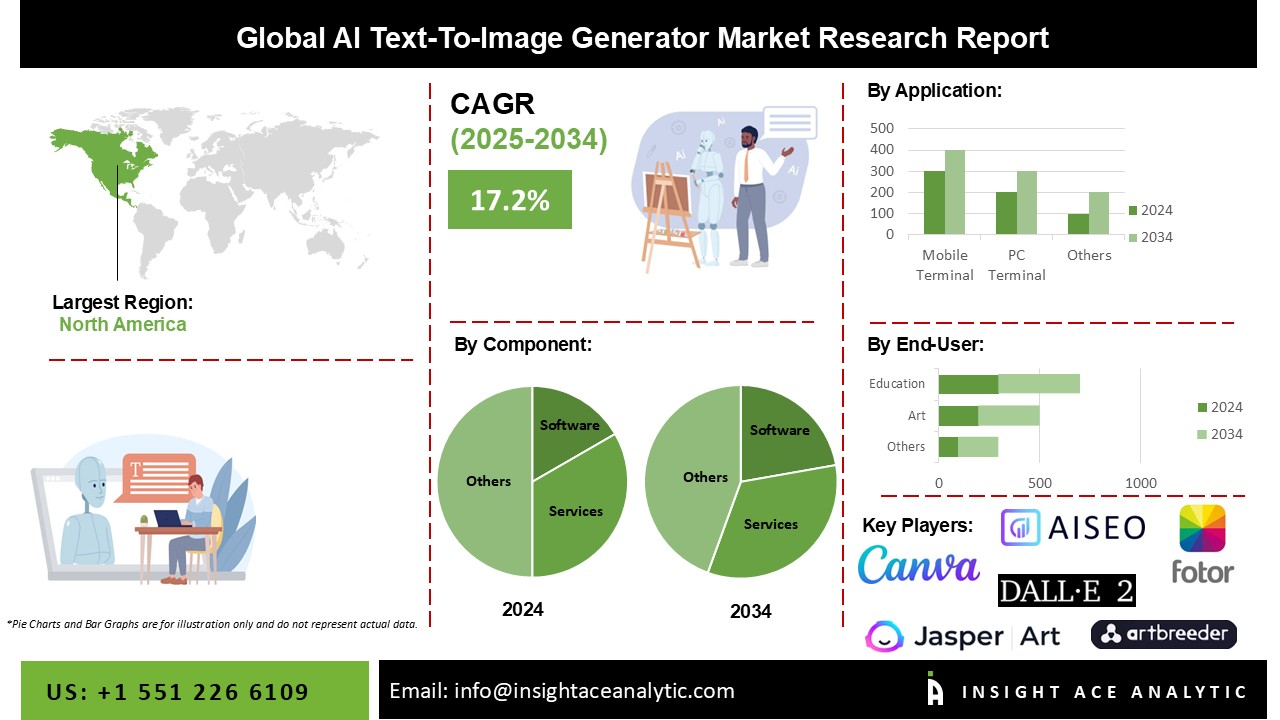
The AI Text-To-Image Generator Market is segmented on the basis of component, application, and end-user. The components segment includes as software and services. The application segment includes mobile terminals and pc terminals. By end-user, the market is segmented into art, education, fashion, businesses, NFTs, and others.
The services category is expected to maintain a major share of the global AI Text-To-Image Generator Market in 2024. It encompasses a wide range of services offered to businesses that use AI text-generation systems. These services aid enterprises in quickly deploying and utilizing machine learning and natural language generation-based solutions, allowing them to fully utilize the potential for text production. The huge expansion in the adoption of AI test-generation tools across a variety of industries is expected to drive demand growth in the future years.
The mobile terminal segment is projected to grow at a rapid rate in the global AI text-to-image generator market. AI text generators are evolving widespread as a valuable tool for copywriters, SEO agencies, and marketers. AI text generators provide consumers with benefits such as increased content consistency, focusing on more macro-level details and optimizing material, and so on.
The North America AI Text-To-Image Generator Market is expected to register the most increased market share in terms of revenue in the near future. Key benefits include improved user experience, higher content creation, more ranked keywords, reduced content production time, and increased investments in developed countries such as the United States and Canada in AI text generator technology. Furthermore, these countries' burgeoning content businesses have fostered the expansion of AI text generators in this region. In this area, the increasing use of technologies such as artificial intelligence (AI), computer vision, machine learning, and deep learning pushes market expansion.
| Report Attribute | Specifications |
| Market Size Value In 2025 | USD 0.48 Bn |
| Revenue Forecast In 2035 | USD 3.07 Bn |
| Growth rate CAGR | CAGR of 20.4% from 2026 to 2035 |
| Quantitative units | Representation of revenue in US$ Billion and CAGR from 2026 to 2035 |
| Historic Year | 2022 to 2025 |
| Forecast Year | 2026-2035 |
| Report coverage | The forecast of revenue, the position of the company, the competitive market statistics, growth prospects, and trends |
| Segments covered | Type, Material, Precursor And End Users |
| Regional scope | North America; Europe; Asia Pacific; Latin America; Middle East & Africa |
| Country scope | U.S.; Canada; U.K.; Germany; China; India; Japan; Brazil; Mexico; The UK; France; Italy; Spain; South Korea; Southeast Asia |
| Competitive Landscape | Photosonic, Jasper.ai Art, Dall-E, Fotor, Midjourney, Nightcafe, Canva, Stable Diffusion, Dreamstudio, StarryAI, AI Gahaku, AISEO, Anonymizer, Artbreeder, Crayon, Deep Dream Generator, DeepAI, Google Colaboratory (Colab), Hotpot, Hypotenuse, OpenAI (Dall-E), WOMBO Dream, Alphr, Pixray, DeepAI, neuro-flash, Lightricks, CodeSandbox, Shutterstock, and Replicate among others. |
| Customization scope | Free customization report with the procurement of the report, Modifications to the regional and segment scope. Particular Geographic competitive landscape. |
| Pricing and available payment methods | Explore pricing alternatives that are customized to your particular study requirements. |
This study employed a multi-step, mixed-method research approach that integrates:
This approach ensures a balanced and validated understanding of both macro- and micro-level market factors influencing the market.
Secondary research for this study involved the collection, review, and analysis of publicly available and paid data sources to build the initial fact base, understand historical market behaviour, identify data gaps, and refine the hypotheses for primary research.
Secondary data for the market study was gathered from multiple credible sources, including:
These sources were used to compile historical data, market volumes/prices, industry trends, technological developments, and competitive insights.

Primary research was conducted to validate secondary data, understand real-time market dynamics, capture price points and adoption trends, and verify the assumptions used in the market modelling.
Primary interviews for this study involved:
Interviews were conducted via:
Primary insights were incorporated into demand modelling, pricing analysis, technology evaluation, and market share estimation.
All collected data were processed and normalized to ensure consistency and comparability across regions and time frames.
The data validation process included:
This ensured that the dataset used for modelling was clean, robust, and reliable.
The bottom-up approach involved aggregating segment-level data, such as:
This method was primarily used when detailed micro-level market data were available.

The top-down approach used macro-level indicators:
This approach was used for segments where granular data were limited or inconsistent.
To ensure accuracy, a triangulated hybrid model was used. This included:
This multi-angle validation yielded the final market size.
Market forecasts were developed using a combination of time-series modelling, adoption curve analysis, and driver-based forecasting tools.
Given inherent uncertainties, three scenarios were constructed:
Sensitivity testing was conducted on key variables, including pricing, demand elasticity, and regional adoption.